← Back to homepage

Haidong (Andrew) Huang

Publications & Manuscripts

* Equal contribution† Corresponding author‡ Project Leader

Overview figure for ActAtlas: Learning Adaptive Execution Atlases for Long-Horizon Robotic Manipulation

ActAtlas: Learning Adaptive Execution Atlases for Long-Horizon Robotic Manipulation

Haidong Huang, Yutong Shen, Heng Zhang, Xingwei Chen, Haiyue Zhu, Jun Ma, Ding Zhao†, Xiaocong Li†

Submitted to The Fifteenth International Conference on Learning Representations (ICLR) 2027

ActAtlas learns adaptive execution anchors and their directed transitions from demonstrations to condition a shared diffusion policy, distinguishing similar-looking states at different task stages and improving long-horizon manipulation.
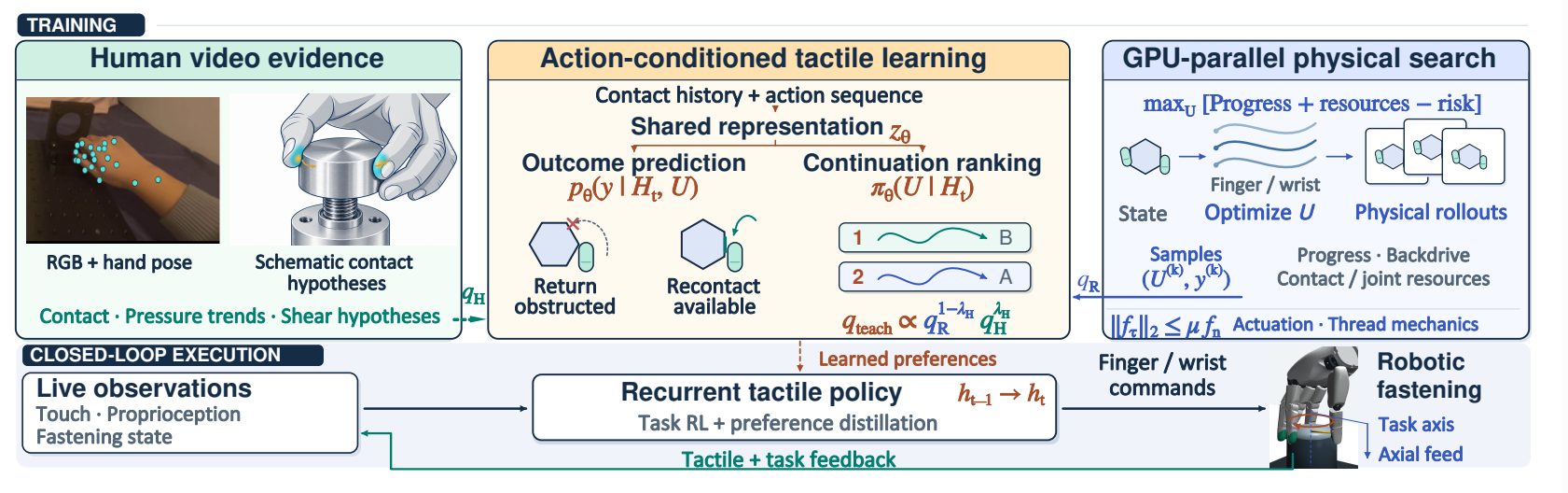
Overview figure for T-FRAME: Tactile Force-aware Representation for Action-conditioned Manipulability Evolution

T-FRAME: Tactile Force-aware Representation for Action-conditioned Manipulability Evolution

Xingwei Chen*, Haidong Huang*, Xiyuan Li, Xuqi Su, Shengjie Qiu, Tang Chong, Xiaocong Li†

Submitted to The Fifteenth International Conference on Learning Representations (ICLR) 2027

T-FRAME combines physics-supervised prediction of action-conditioned contact consequences with uncertainty-aware, video-guided preference learning to train a recurrent tactile policy for reliable, efficient dexterous fastening through repeated contact renewal without online search.

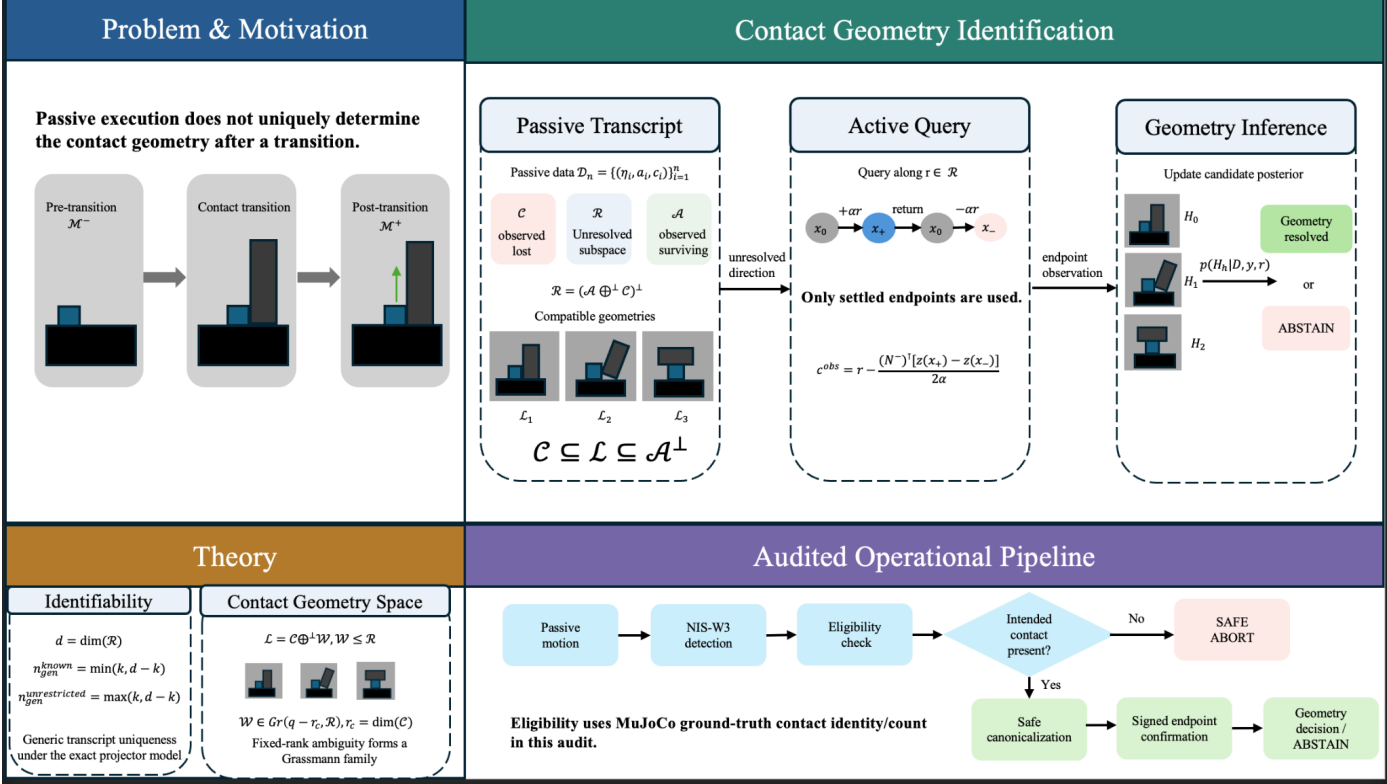
Overview figure for Identifiability and Active Confirmation of Contact Mobility Transitions

Identifiability and Active Confirmation of Contact Mobility Transitions

Xixin Zhao, Haidong Huang, Yaohua Zhou, Jiayu Song, Yuji Yamakawa†

Submitted to IEEE International Conference on Robotics and Automation (ICRA) 2027

RSS 2026 Workshop on Geometry of Motion Oral Presentation

We characterize why passive execution cannot always identify contact-induced mobility loss and derive active-query requirements under an ideal projector model to guide targeted confirmation of newly constrained motions.

Overview figure for Consequence-Quotient Flow Matching for Robot Manipulation

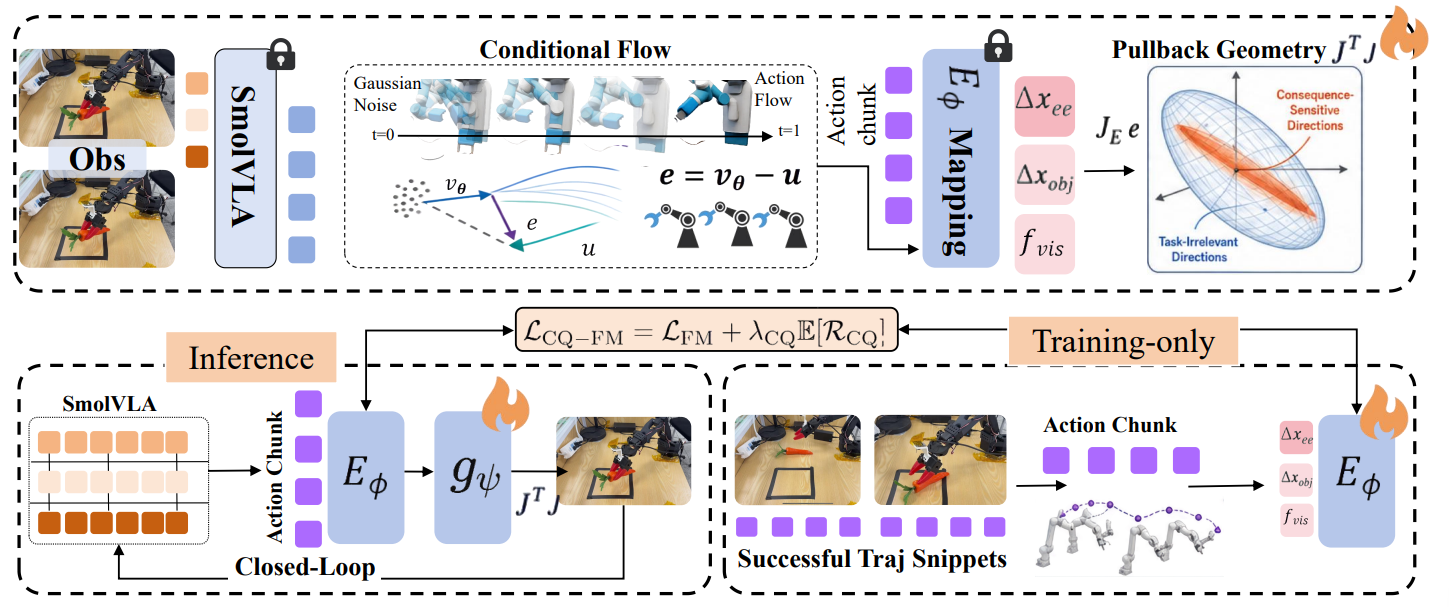
Consequence-Quotient Flow Matching for Robot Manipulation

Yutong Shen*, Haidong Huang*, Heng Zhang, Haoxuan Xu, Yiqing Yin, Xuanhao Zheng, Xuhan Miao, Arash Ajoudani, Lei Zhang, Xiaocong Li†

Submitted to IEEE International Conference on Robotics and Automation (ICRA) 2027

CQ-FM uses learned action-consequence geometry to guide both flow-matching training and safeguarded closed-loop correction, improving task completion without enlarging the vision–language–action backbone.

Overview figure for TA-SmolVLA: Tactile Tokens from Dense Force Fields for Contact-Rich Insertion

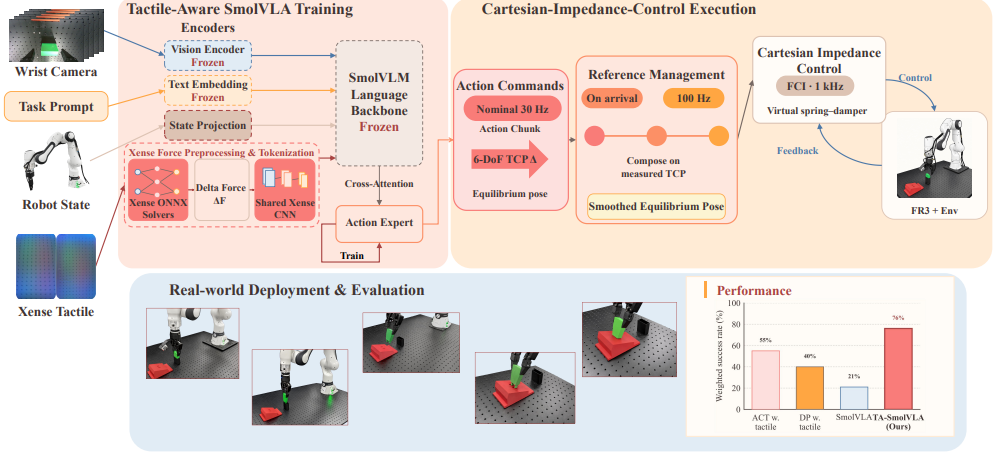
TA-SmolVLA: Tactile Tokens from Dense Force Fields for Contact-Rich Insertion

Xuqi Su, Yichen Wang, Mihael Simonic, Zhenxin Yu, Chan Zhang, Xingwei Chen, Haidong Huang, Yaohua Zhou, Xiaocong Li†

Submitted to IEEE International Conference on Robotics and Automation (ICRA) 2027

TA-SmolVLA integrates bilateral dense force-field tactile tokens into vision–language–action learning and connects generated actions to impedance control for more reliable, compliant plug insertion under wrist-camera occlusion.

Overview figure for A Ranking-Based Performance Normalization Method for Multi-Objective Robot Trajectory Optimization

A Ranking-Based Performance Normalization Method for Multi-Objective Robot Trajectory Optimization

Yaohua Zhou, Haidong Huang, Xixin Zhao, Gang Xu, Xiaocong Li†

Submitted to IEEE International Conference on Robotics and Automation (ICRA) 2027

NRBPEM combines rank-based normalization with sequential weighted-sum optimization to reduce sensitivity to extreme values and objective dominance, achieving faster convergence while maintaining comparable performance in multi-objective robot trajectory optimization.

Overview figure for GeoPreserve: Preserving Action-Relevant Geometry in 3D Diffusion Policies for Long-Horizon Manipulation

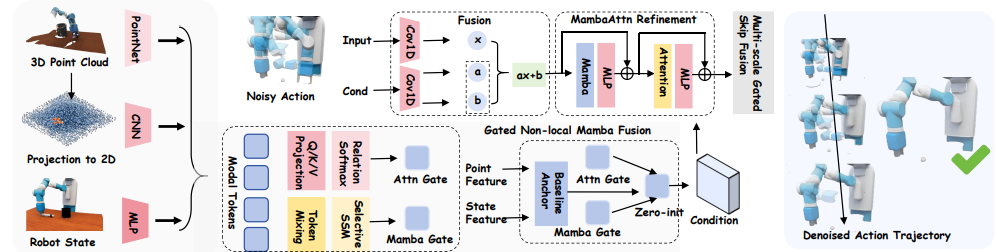
GeoPreserve: Preserving Action-Relevant Geometry in 3D Diffusion Policies for Long-Horizon Manipulation

Haidong Huang*, Yutong Shen*, Xingwei Chen, Heng Zhang, Chenguang Yang, Haiyue Zhu, Jun Ma†, Xiaocong Li†

Submitted to AAAI Conference on Artificial Intelligence (AAAI) 2027

GeoPreserve uses Rewriting–Routing–Recovery to keep action-relevant 3D geometry available from observation encoding through denoising, improving long-horizon manipulation and behavioral diversity while retaining a lightweight diffusion policy.

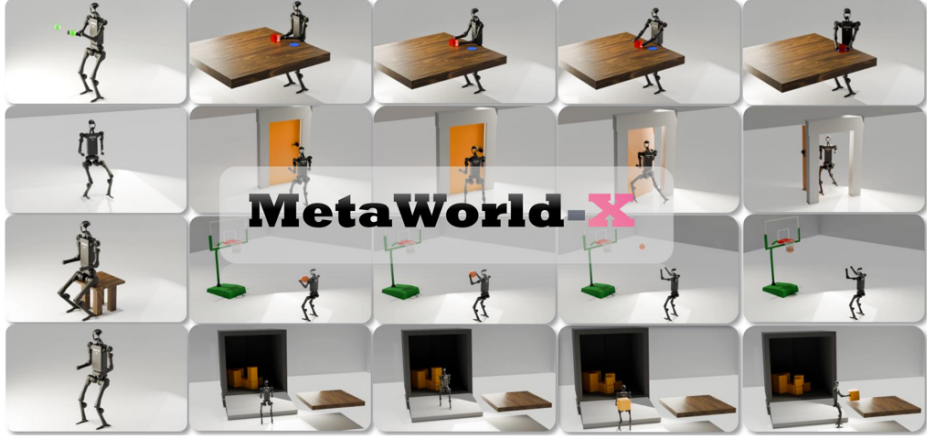
Overview figure for MetaWorld-X: Semantic-Prior Expert Orchestration with Training-Time Latent Model-Based Improvement

MetaWorld-X: Semantic-Prior Expert Orchestration with Training-Time Latent Model-Based Improvement

Yutong Shen*, Haidong Huang*, Heng Zhang, Penghui Liu, Jiashuo Luo, Zhang Shunqi, Chen Jiang, Chenguang Yang†, Arash Ajoudani, Jianwei Zhang, Lei Zhang

Submitted to AAAI Conference on Artificial Intelligence (AAAI) 2027

MetaWorld-X combines a shared latent world model, human-motion-informed experts, and VLM-guided semantic composition to reduce skill interference and support coordinated multi-stage humanoid loco-manipulation.

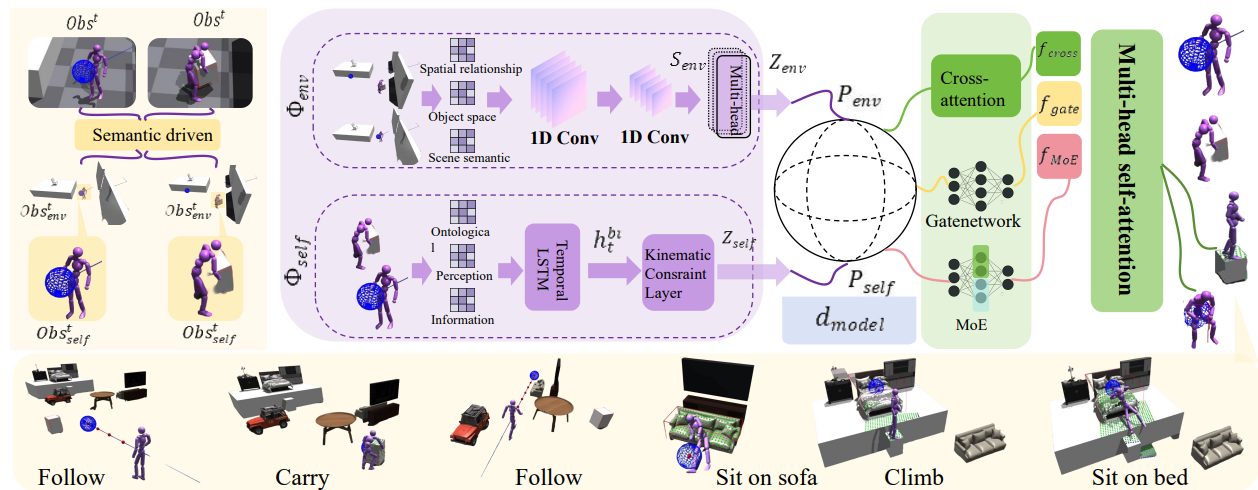
Overview figure for ALAS: Adaptive Long-Horizon Action Synthesis via Disentangled Environment and Self-State Representations

ALAS: Adaptive Long-Horizon Action Synthesis via Disentangled Environment and Self-State Representations

Yutong Shen*, Haidong Huang*, Lei Zhang, Penghui Liu, Yinqi Liu†

Submitted to IEEE Humanoid 2026

ALAS disentangles environmental context from self-state dynamics and adaptively fuses these representations to improve cross-scene transfer, skill reuse, and long-horizon human–scene interaction.

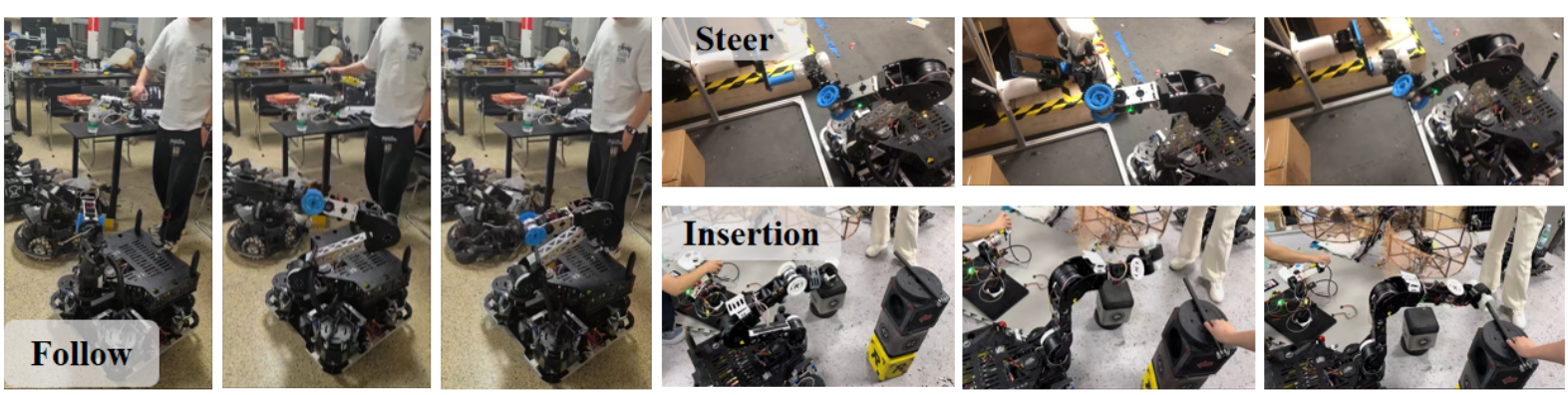
Overview figure for Preserving Operator Intent Under Actuation Constraints: Teleoperation of Manipulators with Coupled Transmissions

Preserving Operator Intent Under Actuation Constraints: Teleoperation of Manipulators with Coupled Transmissions (Project Leader)

Xuhan Miao, Zijin Han, Yutong Shen, Haidong Huang‡, Shanliushui Gao, Lei Zhang, Xiaocong Li, Chenguang Yang†

Accepted by 5th Sensorimotor-Augmented Teleoperation Workshop @ IEEE/RSJ International Conference on Intelligent Robots and Systems (IROS) 2026 Oral Presentation

Our teleoperation framework combines gravity-aware actuator-space projection with continuous feasible-reference updates to preserve operator intent and reduce coordination distortion and recovery transients in manipulators with coupled transmissions.

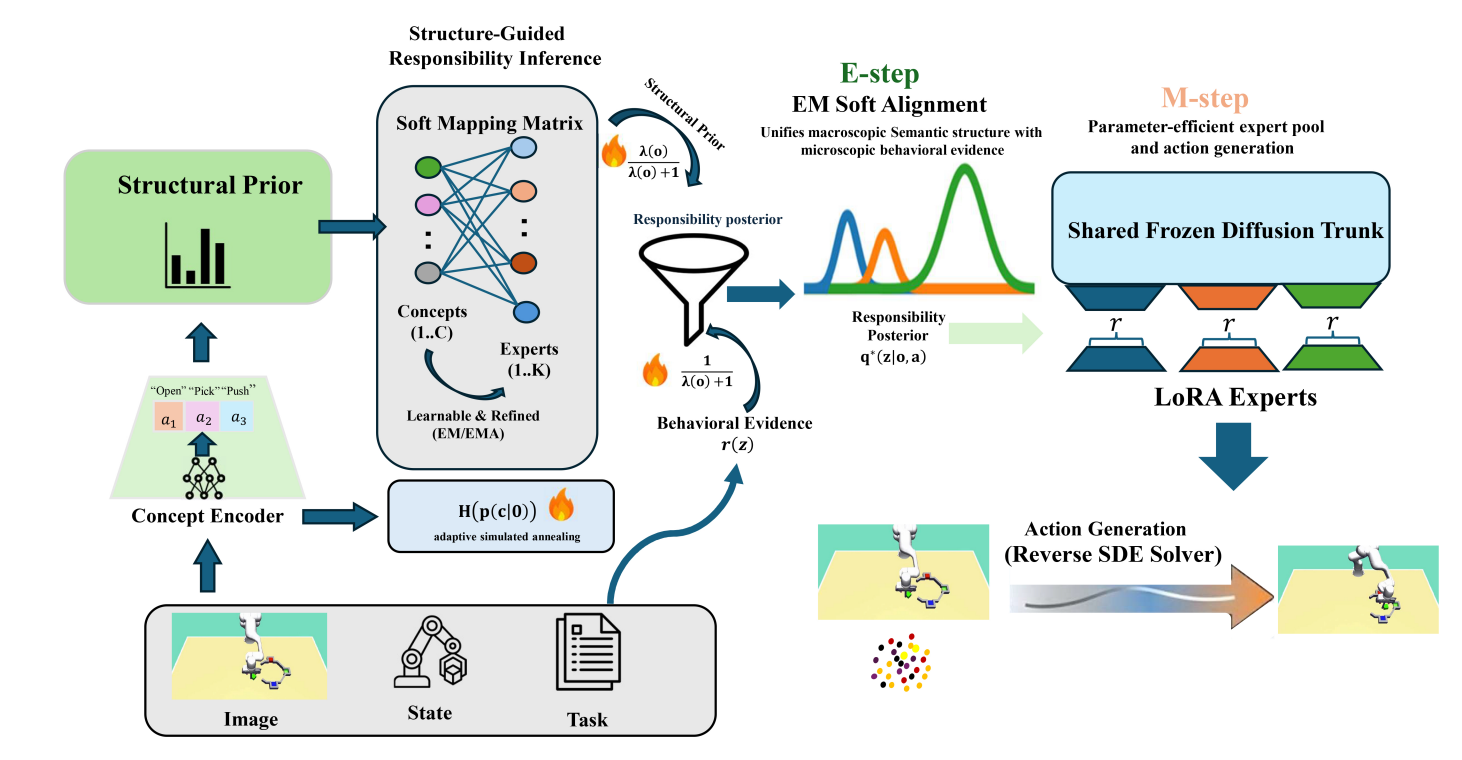
Overview figure for CoRDE: Concept-Prior Routed Diffusion Experts for Structural Generalization in Robot Manipulation

CoRDE: Concept-Prior Routed Diffusion Experts for Structural Generalization in Robot Manipulation

Haidong Huang, Xixin Zhao, Yaohua Zhou, Jiayu Song, Jiayi Zhang, Jun Ma, Haiyue Zhu, Xiaocong Li†

Accepted by IEEE/RSJ International Conference on Intelligent Robots and Systems (IROS) 2026 Oral Presentation

Received a $1,500 travel grant from IEEE RAS.

CoRDE fuses concept priors with behavioral evidence to guide parameter-efficient LoRA diffusion experts, reducing routing collapse while preserving diverse behaviors in multi-task manipulation.

Overview figure for Joint-Angle Invariance of Jacobian-Based Performance Indices for Serial Robotic Manipulators

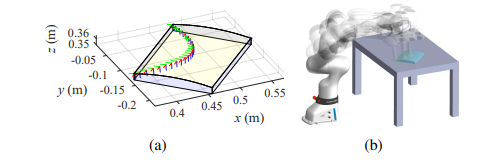
Joint-Angle Invariance of Jacobian-Based Performance Indices for Serial Robotic Manipulators

Yaohua Zhou, Mingdao Lin, Jiayu Song, Xixin Zhao, Haidong Huang, Jiahu Qin, Xiaocong Li†

Accepted by IEEE/RSJ International Conference on Intelligent Robots and Systems (IROS) 2026 Oral Presentation

We identify when Jacobian-based performance indices are invariant to the first and last joint angles, enabling lower-dimensional performance mapping and task-layout optimization with reduced computational and storage costs.

Overview figure for Opinion: Towards Unified Expressive Policy Optimization for Robust Robot Learning

Opinion: Towards Unified Expressive Policy Optimization for Robust Robot Learning

Haidong Huang, Haiyue Zhu, Jiayu Song, Xixin Zhao, Yaohua Zhou, Jiayi Zhang, Yuze Zhai, Xiaocong Li†

Accepted by EWM Workshop @ Conference on Neural Information Processing Systems (NeurIPS) 2025 Spotlight

UEPO combines multi-seed diffusion sampling, dynamic divergence regularization, and trajectory augmentation to broaden behavioral coverage and improve dynamics-model generalization for offline-to-online robot learning using a single generative policy.